
Building Community Power: Inside the Little Jamaica Community Land Trust
This interview is a follow-up to a previous essay we wrote¹ about the financialization of housing. In that essay, we analyzed the impact of the commodification of housing in Canada on housing supply and affordability. Shortly after the release of this essay, we held the Black Earth 2.0 Office Hours, where we discussed food sovereignty and the feasibility of urban growing. What ties both works together is the idea that communal, rather than private, ownership of land and resources is the key to our communities thriving.
Sadly, the logic of the economic system we live under today is antithetical to communal ownership. Despite this, there are still groups that attempt to wrestle back control for themselves and their communities. In the research for our essay on housing, we spoke with Anyika Mark, a founder of one such group, called the Little Jamaica Community Land Trust (LJCLT). As the name suggests, The LJCLT is a community land trust (CLT), which is “a model of collective land stewardship based on the belief that land should be held and managed for the benefit of local communities.”² These organizations are local non-profit entities that aim to permanently develop and steward land in their area with projects such as affordable housing, commercial spaces, agricultural lands, and cultural spaces. While the first ever CLT to go by this name was New Communities Inc³, a civil rights era organization founded as a haven for African American farmers, the concept takes inspiration from various indigenous pre-capitalist forms of land stewardship throughout the world. We’ve collected source material for those who wish to study the history and theory of the CLT in depth, but for our purposes, the key features of a community land trust are⁴:
Permanent land stewardship: A CLT is not an investment property: they will never sell their land.
Perpetual affordability: Housing and other properties owned by the CLT are affordable forever
Expansionist: CLTs create a community owned real estate portfolio with the active goal of acquiring and developing more properties for the community.
Place-based: CLTs serve a certain geography, ranging from neighbourhoods to entire regions.
Community-led: A membership and elected board that includes both CLT residents and community members makes all relevant decisions.
Community benefit: CLTs directly benefit communities by enabling access to housing and other identified needs, while also playing important advocacy and community-building roles.
Historically, CLTs have been founded to serve a specific community. New Communities Inc was founded as a part of the civil rights movement and the struggle against segregation. The Little Jamaica Community Land Trust was founded as a response to the concerns of Black people living in Little Jamaica (also known as Eglinton West) regarding the Eglinton Crosstown LRT Project. Fifteen years in the making, and as of writing still facing delays⁵, this train line has disrupted Black businesses along Eglinton Ave W. The loss of business from the ongoing construction has raised fears in the community regarding impending gentrification and cultural erasure. A lack of action on these concerns from the City of Toronto and the nearby Business Improvement Areas⁶ led to the creation of the LJCLT to protect the community from displacement.
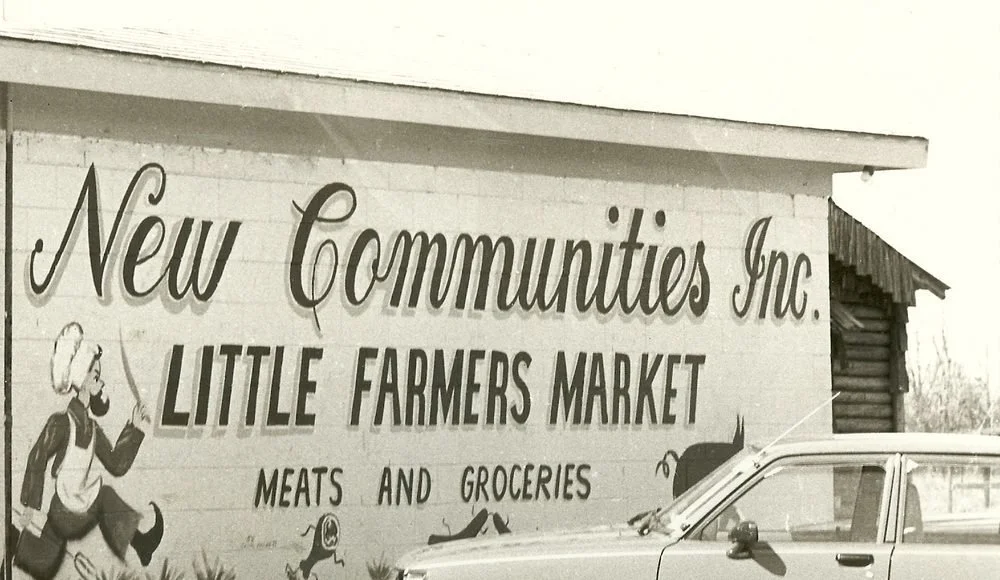
Market operated by the New Communities Inc CLT in Leesburg Georgia.
While our interview with Anyika initially focused on the housing aspects of CLTs, she made it clear that CLTs are about more than just this. CLTs are about controlling the destiny of a community and shielding it from external pressures. As the LJCLT states themselves “LJCLT is not just a housing entity, it is not just a steward of commercial space: it is a vehicle for self-determination in a historic Black community and will provide it all: housing, retail, community space and more.”
We thank Anyika Mark and the Little Jamaica Community Land Trust for this interview and we hope you enjoy it.
What is the Little Jamaica Community Land Trust (LJCT) and how did you get involved with it?
Little Jamaica Community Land Trust or LJCLT. I'm a part of the founding team, incubating the LJCLT. We began this work through Black Urbanism TO, a non-profit organization with a mission to increase Black people's participation in community development. In 2018, we were really concerned with the gentrification happening to Eglinton West, Little Jamaica, a place we all call home. The Eglinton Crosstown LRT project officially began in 2015 and devastated Little Jamaica in multiple ways. The City of Toronto followed up with a planning framework study (eglintonCONNECTS⁷) that completely erased the living and historical presence of Black people in the neighbourhood. This is what kick-started our work. We started off by holding consultations with residents, business owners and community leaders about the planning framework study and other concerns they had. Through our engagements, we realized that Black folks had very little ownership in the properties they operated in or their business spaces- meaning they could be displaced at any moment. During our consultation series in 2020, we invited the Parkdale Neighbourhood Land Trust to make a presentation on how we could activate the Community Land Trust Model in Little Jamaica. In 2021, we received philanthropic funding from the Metcalf and Atkinson Foundations to begin our research project, and report, Pathways to Community Ownership: Protecting the Economic Future of Little Jamaica⁸. Once completed, the Metcalf and Atkinson Foundation provided operational funding for Black Urbanism TO to officially incubate the Little Jamaica Community Land Trust, which was federally incorporated in November 2022.
Today, the LJCLT has an Interim Board, will be holding its first public AGM in 2026 and has two staff representatives. The LJCLT’s mission is to acquire property and steward resources to drive the heritage preservation and self-determination of diverse Black diasporic peoples in a sustainable way for residents and businesses. LJCLT is proud to put forward a proof of concept for other Black communities in the city to build from and also contributing to the rising tide of Black land stewardship across Canada. From the $60M secured for housing in Upper Hammonds Plains, to Hogan's Alley Society reclaiming space in Vancouver with mixed-use acquisitions, to the preservation of the historic Mount Beulah Baptist Church in Weymouth Falls—the Black-led CLT movement is growing. This is how we fight gentrification, preserve integral cultural heritage and ensure permanent stability of Black people across the country.
What role do you think community land trusts should play in the provision of housing?
I believe that community land trusts are one of many housing solutions. The community land trust is a non-profit entity which means two important things. One, a board of directors, from said community, govern the processes and stewardship of buildings and land. With the right team, a CLT could strive to meet the nuanced needs of their users and the broader neighbourhood. Second, for-profit desires that currently exist in the housing market cannot be applied to a non-profit model, as per Canadian federal laws. This means housing can be prioritized as a human right and not a means of enriching an individual/collective of people. However, I believe there is still a role our public sector, particularly our provincial and federal governments, need to play for CLT models to truly be successful.
Additionally, the Pathways to Community Ownership Report highlights several models that the community could activate!
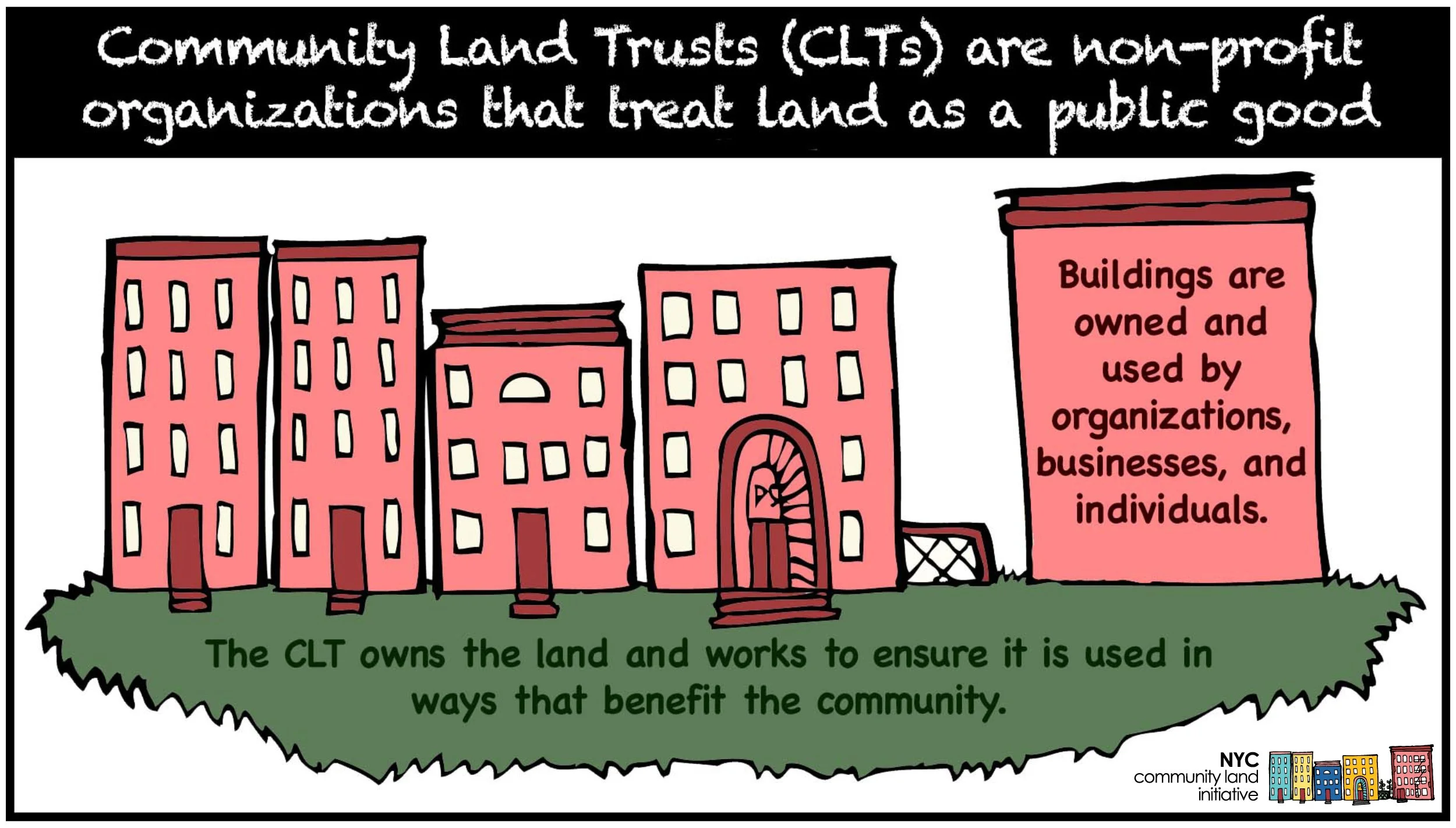
Graphic by NYC Community Land Initiative
How would you advise people wishing to start community land trusts?
The first step is getting like-minded individuals together, from different sectors, industries and who have specific expertise. Whether that's housing, real estate development/sale, city staff, community organizers, lobbyists- this collective of people can incorporate a CLT through the federal and provincial incorporation process for non-profits. However, a CLT is a risky organization. It involves the purchase and sale of property, managing units, and managing millions of dollars in debt, (to some capacity, whether that's community bonds or mortgages) so the group you've assembled must be dedicated to the mission, & have the necessary expertise to make it successful. It's also important to establish political partnerships, especially with local governments. These folks will be the champion of your project, your story and for public dollars towards social housing projects.
Do you feel like community land trusts are a good first step toward true communal ownership of land and resources?
I do think CLTs are a good first step toward true communal ownership of land and resources. Collective fundraising, mutual aid and community funds have existed in cultural communities for a very long time and have been a part of our traditional ways of being. The CLT model provides a vehicle for these traditions, within the existing colonial framework. However, we are still participating in the colonial state and its ways of acquiring property, along with reinforcing the idea that private property SHOULD exist. It is critical to understand this work not as an end goal, but as a strategic maneuver toward deeper liberation. As Shekara Grant from Weymouth Falls Community Land Trust⁹ powerfully stated at the LJCLT Launch Event, "true communal ownership would be our ability to return land back to itself.”
For Black communities on Turtle Island, land stewardship is not just a solution to displacement; it is a pathway to healing and self-determination. By taking land off the speculative market and placing it under community control, we create a tangible mechanism to answer the call for #LandBack, not just as a concept, but as a practiced responsibility. These are questions I hope to explore more with LJCLT Board and Membership as we undergo a strategic planning process and targeted member outreach.
However, I do think CLTs are a necessary first step.
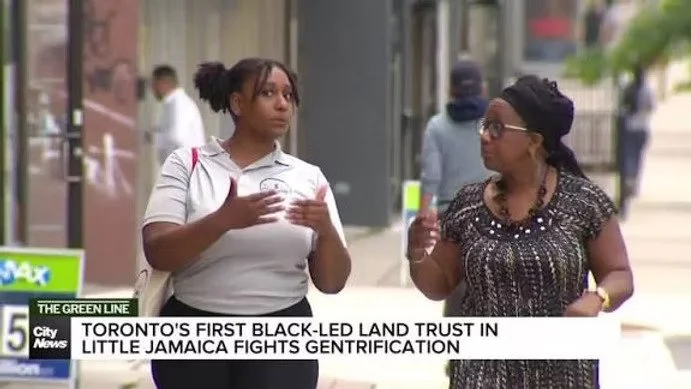
Anyika Mark photographed on and published on City News discussing the work of LJCLT
Are the challenges you faced in establishing CLTs unique to Toronto or do you think they’re more universal?
I think that everyone's context is unique, because CLT's are geographical and based on community needs. So, a challenge in Toronto's Little Jamaica may not be a challenge in Toronto's Chinatown, even though we exist in the same municipality with very similar origins to place-making. I think the biggest, and most universal challenge, is the capital for acquisition. Once you can lock down important governance (policies, staff capacity, board of directors, membership base/process, stewardship strategy, acquisition strategy), the question becomes- where is the money for the project. In a conservative political landscape, we see less opportunities for public funds to be accessible to public entities for housing. This means CLT's may need to develop partnerships with those in the private sector, finding an equitable balance with developers between the community needs and private interests.
References
1919. The Financialization of Housing. 1919 Magazine. https://1919mag.com/publication/2025/09/30/financialization/of/housing
Canadian Network of Community Land Trusts. Community Land Trusts: Frequently Asked Questions. https://www.communityland.ca/wp-content/uploads/2024/04/9-EN-CLT-101-one-page-folded.pdf
Elliot, Debbie. 5 Decades Later, New Communities Land Trust Still Helps Black Farmers. NPR. https://www.npr.org/2019/10/03/766706906/5-decades-later-communities-land-trust-still-helps-black-farmers
See 2)
Westoll, Nick. Eglinton Crosstown LRT revenue service demonstration ‘paused’ after ‘incident’: minister’s office. https://toronto.citynews.ca/2025/10/21/eglinton-crosstown-revenue-service-demonstration-paused/
Business Improvement Areas (BIAs) are associations of commercial property owners and business tenants that pool funds together for improvements of their area.
City of Toronto. Eglinton Connects. City Planning Division. https://www.toronto.ca/city-government/planning-development/planning-studies-initiatives/eglinton-connects/
Black Urbanism TO. Pathways to Community Ownership. Black Urbanism TO (BUTO). September 2023. https://www.ljclt.ca/_files/ugd/444d95_db243e7d4fc94146bcaa4e92a0770521.pdf
Weymouth Falls Community Land Trust. About Us. https://www.weymouthfalls.ca/about-us/
Further Reading
Canadian Network of Community Land Trusts. About Community Land Trusts. https://www.communityland.ca/faqs/
Swann, Robert et al. The Community Land Trust: A Guide to a New Model for Land Tenure in America. Center for Community Economic Development, Cambridge, MA, 1972. https://centerforneweconomics.org/wp-content/uploads/1972/06/Introduction-to-the-1972-edition-of-The-Community-Land-Trust-Handbook.pdf
Davis, John Emmeus, editors. The Community Land Trust Reader. Lincoln Institute of Land Policy. Cambridge MA, 2010. https://www.lincolninst.edu/app/uploads/legacy-files/pubfiles/the-community-land-trust-reader-chp.pdf