
Pan-Africanism & Black Canadians
Understanding Black Canadian History
In December 1995, the Canadian House of Commons passed a motion to officially recognize February as Black History Month in Canada. While this month was dedicated to the Black community in Canada specifically, February was chosen in large part because the Americans had their Black History Month in February. Given the history of both countries, this was sensible. Many of the earliest Black people to live in what is now Canada were ex-slaves from America. But while Black Americans are a distinct, highly visible nation, whose Black History Month is dedicated to their unique history and its inheritors, we cannot say the same for Canada. Black Canadian identity does not exist in the same way Black America’s does. While Black people have been in Canada since its inception, unlike our American counterparts, there is little direct lineage between these early peoples and the majority of today’s Black Canadians. This disconnect poses unique problems for the idea of a Black Canadian identity and community. Jessie Lipscombe, a fourth-generation Albertan and Black Canadian, summed this up when he told CBC; “I don't feel that connected to a Black community ... A lot of my Black friends know where they're from, and so they have like a Jamaican community, or a Nigerian community, and they have places and things. I don't have that and I don't know what that is”¹.
Like Jessie, neither do we. But, we also don’t believe our communities need to feel so disconnected. Black Canadian identity has always co-evolved with the diaspora communities that have migrated here. Studying their history through a pan-African lens can help us see that the connections have always been there, and acknowledging them can give us the chance to rekindle them.
For most of Canadian history, there have only been small numbers of Black people living here. This lack of visibility made it easy to spread myths about our origins, especially ones that Canadians preferred to believe about themselves and their benevolence. Historians have done an excellent job at popularizing Black Canadian history while also countering the myths surrounding it. Barrington Walker, one such historian, has written about the Underground Railroad as an example of this myth making. He explains how Canadians, accustomed to celebratory histories of the country as a refuge for runaway slaves, were slow to accept more critical (accurate) accounts of the Underground Railroad. Relying mainly on White abolitionist writings, historians would try to present Canada as a “pure haven from [chattel] slavery”² (Walker 2022), when in reality, slavery was commonplace in what is now Canada from the very start of the settler colonial project. The French and British settlements both had their own laws permitting and enforcing racial slavery of Black and Indigenous people. When the British gained control over all of pre-Confederation Canada, these legal systems remained in place. The abolition of slavery in the British Empire was an important victory, but it did not transform its Canadian colonies into an oasis. Even after the American War of Independence, where the panicked British promised emancipation to Black slaves who fought on their side, the haven the abolitionists spoke of did not materialize. The so-called³ Black Loyalists that migrated to Nova Scotia after the war struggled against segregation and an oppressive colonial state. This would become a familiar story for every migration of Black people into Canada from America; from those liberated through the Underground Railroad, to the migrants that fled California for Vancouver Island, and the ranchers that left Oklahoma for the Canadian Prairies. While Canada was advertised as a haven, it was (at best), simply the lesser of two hells.
If you asked them, the goal of these early Black peoples was not to become Canadian, but instead to find a place that would “afford them dignity as individuals and as a people”⁴. While they were Black, and having made their home in Canada rightfully called themselves Canadian, their struggle was never solely Canadian in scope. Many retained family ties to America, and with American annexation viewed as likely or inevitable⁵, its politics loomed large on their conscience. This threat is arguably the main reason that a Canadian national identity (rather than French or British one) even exists at all. But for all its attempts to build a national identity distinct from the United States, Canada has never had issues emulating it when convenient. The Canadian transcontinental railway, the physical embodiment to the nation’s distinctness from the Americans, was, in the end, built by American railway industrialists⁶. The Canadians also staffed their railway cars just like the Americans, so, the porters on these cars were almost exclusively Black men. Histories of these porters such as Sara Mathieu’s North of the Color Line and Cecil Foster’s They Call Me George detail how the Canadian porters fought for the same things as the American porters (labour rights, an end to segregation, and full citizenship) and were part of the same unions. The interconnectedness of their industries and their struggles mean that their stories cannot be neatly divided along national lines. They’re an example of how the movements of Black people between and across nations have created shared histories and struggles that unite them. Some theorists even go as far as to say that because of this, the whole idea of discrete national Black identities (Black American, Black Canadian, Black British, etc.) is missing the forest for the trees. The sociologist Paul Gilroy formalized this idea, arguing that all Black peoples in the Americas and Europe were part of a transnational and intercultural group he calls the Black Atlantic. In his words:
“The history of the black Atlantic [...], continually crisscrossed by the movements of black people — not only as commodities but engaged in various struggles towards emancipation, autonomy, and citizenship-provides a means to reexamine the problems of nationality, location, identity, and historical memory.”
While the idea of a Black Atlantic risks glossing over the unique ways Black peoples relate to their nations, it’s a useful theory to analyze how Black Canadian identity evolved through its relationships with other Black diasporas in the Americas.
While the first Black peoples in Canada mainly came from America, they would soon be followed by a larger contingent of Caribbeans, mainly from the British Empire (or the nations that won independence from it) and Haiti. Unlike the Americans, these people were not all looking for a new home. Many of these recent arrivals were looking to work and accumulate funds or attend post-secondary with the express goal of returning to their home nations. Their goals upon their return to their countries varied. Some were children of the colonial elite and middle class, and were looking to cement this position. Others were involved in their national liberation movements, and were looking to gain the tools necessary to overthrow the colonial order. Whatever their goals, their stay in Canada forced them all to confront two unfortunate truths. First, despite their invitation into Canada, they were not welcome here; discrimination against Black people in housing, employment, and everyday life was unavoidable. Second, the class and cultural differences between themselves and the existing Black communities meant that they remained isolated and disorganized. Despite their differences, their treatment by Canadian society and their aspirations for national independence required a re-alignment towards improving their conditions.
Black Power and Pan-Africanism were natural guiding ideologies for this re-alignment. In contrast to white supremacy, the philosophical justification for their treatment at home and abroad, Black Power was about self-defence and resistance against racial supremacy. Black Power asked Black people to “unite [and] recognize their heritage” (Hamilton and Ture) and develop mass organizations that could assure their self-determination. Pan-Africanism, a movement that seeks to unite peoples of African descent under a common political framework, is different in scope but inseparable from this concept. Faced with colonial subjugation at home, racism in Canada, and a divided local Black population, the twin movements of Black Power and Pan-Africanism presented a path towards liberation on all fronts. Student groups in the mid-1960s like the Caribbean Conference Committee (CCC) in Montreal took up this path, and would mark a new chapter not just in Canadian history, but global Black history.
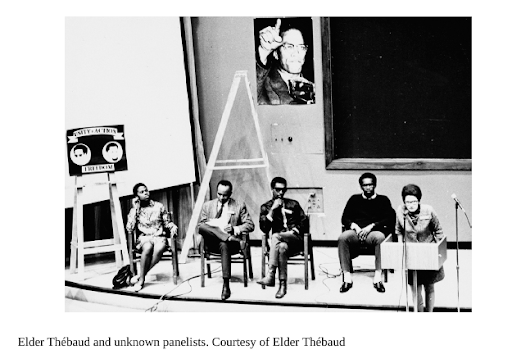
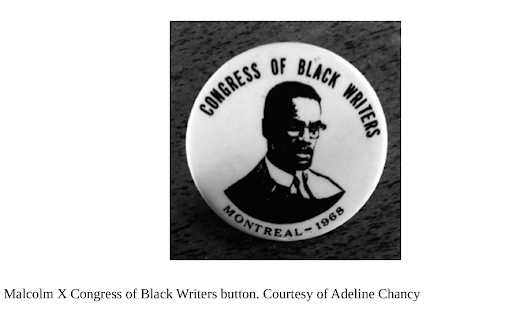
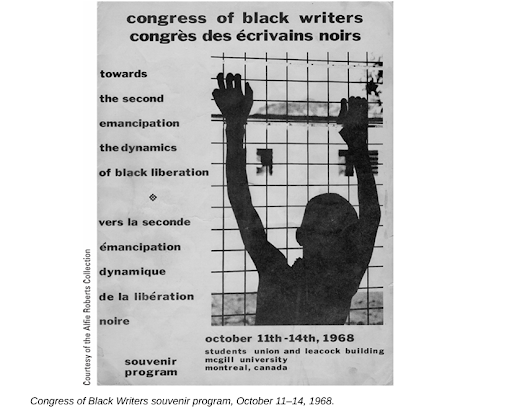
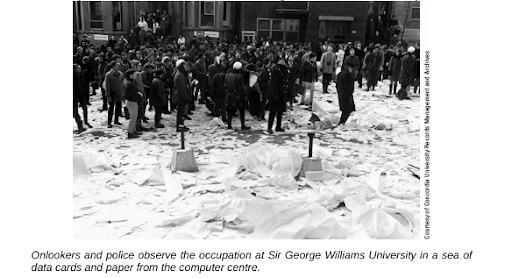
In 1968, the CCC organized The Congress of Black Writers at McGill. Dedicated to the memories of Dr. Martin Luther King Jr., and Malcolm X, and titled “Towards the Second Emancipation, The Dynamics of Black Liberation” it was explicit about its global political objectives. The congress brought together intellectuals from the Caribbean (C.L.R James and Walter Rodney) with their American (Harry Edwards and Stokley Carmichael aka Kwame Ture) and Canadian (Rocky Johnson) counterparts to lay out the case for anti-colonial solidarity and Black Power. In his account of that moment, David Austin wrote “... that long Canadian Thanksgiving weekend in October 1968, the Congress of Black Writers temporarily transformed Canada and Montreal into the center of the Black Power Movement” (Austin 2007). The same students that organized the congress, emboldened to fight racism in Canada as they fought for independence at home, would later stage a sit-in at the Sir George Williams University computer lab to protest a professor who was notorious for undeservedly failing Black students. The police would later violently break-up the sit-in as a fire broke-out in the building, resulting in several injuries and the death of one protestor, Coralee Hutchison. While several sit-in members faced deportation, prison sentences, and expulsions, no police officers, or university staff faced any repercussions. Despite this, Dave Austin credits the incident for helping spark the Black Power movement in Trinidad and Tobago, and members of the CCC went on to become activists and statesmen as their nations won independence.
If the first era of Black Canadians could be summarized as ex-slaves seeking liberty and dignity, the second era could be understood through the congress of 1968 and its aftermath; people conscious of their shared history, connected globally, and struggling to overturn an established order that denied them (and others) liberty and dignity.
Gilroy’s Black Atlantic asks us to think about Black Canadian culture as one manifestation of an intercultural group that exists across nations. While our look at history has provided some evidence for that, it’s difficult to do the same when we look at our present. Today, there are more Black Canadians than ever before, and yet, Black Canadian identity and communities are even more divided than they were in the 1960s. Our civil society organizations are weakly connected (if at all) and most are dedicated to specific diasporas rather than a Black community as a whole. Additionally, whereas the Black Atlantic may be (somewhat) applicable to all Black peoples from the Americas, it has little relevance to the large Black African and Afro-Latin diasporas that are now in Canada. While all of them come together to form a Black identity in this country, they have traceably different origins, and less overlapping history. The biggest critiques of concepts like the Black Atlantic and movements like Black Power are that they insist on a cultural and historical unity between Black peoples that simply does not exist. Pan-Africanism, our preferred framework, is spared from this critique since it is founded on a political solidarity that doesn’t require cultural or historical continuity. This is crucial because it is not possible to unify all of our ethnic, national, linguistic, and religious identities into a single common history. Being “Black” only makes sense in the context of a common experience of racial subjugation. Newer immigrants, particularly from African countries, likely haven’t experienced this. In their homeland, religion or ethnicity will more likely be the common divider of identities⁷ than race. So, in a very real sense, they become Black in Canada.
The incongruence between self-identification and racialization for Black Canadians betrays deeper contradictions in Canadian multiculturalism as an ideal and a practice. Canada, originally the product of a (forced) bicultural merger of French and English, now officially recognizes the multicultural heritage of immigrants outside of these founding peoples. In theory, instead of encouraging (or forcing in the case of Indigenous peoples) assimilation into one of the two dominant cultures, multiculturalism encourages the self-identification and preservation of immigrants’ culture as they integrate into Canadian society. However, with Canadian ideas of race largely unchanged from its history, we don’t get to identify themselves solely on their own terms. Upon our arrival, the Sudani Arab, the Wolof, and the Dominican discover that, according to Canadians, they are all Black. Becoming racialized in this way elicits a range of reactions. We see this range in surveys about Black identity like the Black Canadian National Survey (BCNS). In this survey, 56% of Black people said that being Black was somewhat or very important to them while the other 44% said it wasn’t important at all (Foster et al.). What explains this divergence? To speculate, those who think being Black is not important might see Blackness as irrelevant to their sense of self, less important to them than other identities, or even as negative and degrading⁸. The ones who think it's important might have pride in their Blackness, viewing themselves as connected to a unique culture and able to form stronger bonds with other Black people because of it.
While personal attitudes and self-identifications vary, there’s collective agreement on the effects Blackness has on our quality of life. In Policing Black Lives, Robyn Maynard details how the same forces of state and societal violence that defined Canada’s anti-Black past have been carried into its present. Her expansive work examines the harms Black people face in their interactions with immigration services, migrant labour programs, police, the courts, and child welfare systems. Works like hers confirm a shared experience of injustice and precarity, exemplified by the 84% of Black people surveyed in the BCNS that cite racism as a serious or very serious problem (Forne et al.). Across diasporas and self-identifications, the creation of dedicated Black focused professional, civic, and cultural associations are a reaction to this. While there may be Canadians that hold a specific prejudice for a narrow Black diaspora group, it's understood that anti-Blackness is the more likely and more tangible threat, and it informs the basis for Black solidarity (politically and socially) in Canada.
In the end, it might be more accurate to call us Canadians who are Black rather than Black Canadians. Black Canadians don’t exist in isolation, and they have always been connected to Black diasporas from all over the world. Jessie Lipscombe spoke about seeing diasporas that “knew where they were from” unlike himself and how it made him feel disconnected. It turns out, the feeling is mutual. Dozie Anyaegbunam, a relatively new immigrant from Nigeria, recently wrote about how during February he celebrates a history that is his “by colour and not by lineage” (Anyaegbunam). To him, and to many of us, “colour” is not a meaningful feature. Between this and his newcomer status, he also felt disconnected from a Black community. Dozie would end his article by acknowledging that we don’t need a shared ancestry to understand each other or work together. We couldn’t agree more. If we understand pan-Africanism to be a movement of solidarity between Black peoples, then the history of Black people in Canada has always had a pan-African character. So, beyond lineage or colour, it is the bonds we form across groups, the politics we adopt, and the cultural work we produce that will determine the nation (and world) we build together.
Notes
Italics are our own and added for emphasis
(Walker 2022)
We say “so-called” here because it seems clear to us that most of the Black Loyalists fought for their freedom above all else. Their “loyalty” to the British Crown is better explained by their desire for emancipation and full-citizenship than a committed anti-republicanism. See James W. St. g Walker’s The Black Loyalists and Alan Gilbert’s Black Patriots and Loyalists for more detail.
Quote taken from the Amber Valley Journal (Wolters 2017)
Martin Delany, a Black abolitionist organizer that moved to Chatham Ontario, viewed the (in his mind inevitable) American annexation as the biggest threat to a Black Canadian community (Delany 1852). Even thirty years later, during a trip to Montreal, Friedrich Engels would write a letter saying that Canada was “half-annexed already socially” and believed the Canadians in the prairies would themselves begin clamoring to join the United States (Engels 1888).
There were also cases where Canadian born railway industrialists were key in building some American lines (Cruise and Griffiths).
This is a common view but the most recent memorable example is from writer Chimamanda Adichie (Winterhalter).
Immigrants from the Horn of Africa often report negative associations with Blackness (Stolte 2024). In extreme cases this can even lead to outright racism against Black people. Newer generations are less likely to have this association, and should play a greater role in countering them.
Bibliography
Anyaegbunam, Dozie. “Every February, I Celebrate a History That Is Mine by Colour but Not Lineage.” CBC, 16 Feb. 2026, www.cbc.ca/news/canada/first-person-black-history-month-borrowed-ancestors-9.7087481.
Austin, David. “All Roads Led to Montreal: Black Power, the Caribbean, and the Black Radical Tradition in Canada.” The Journal of African American History, vol. 92, no. 4, 2007, pp. 516–39. JSTOR, http://www.jstor.org/stable/20064231. Accessed 27 Feb. 2026.
Cruise, David, and Alison Griffiths. Lords of the Line: The Men who Built the CPR. Markham, Ont. : Penguin Books, 1989.
Delany, Martin Robison. The Condition, Elevation, Emigration, and Destiny of the Colored People of the United States. Project Gutenberg, 2005. https://www.gutenberg.org/files/17154/17154-h/17154-h.htm.
Engels. Letters: Marx-Engels Correspondence 1888. www.marxists.org/archive/marx/works/1888/letters/88_09_10.htm.
Foster, Cecil. They Call Me George: The Untold Story of The Black Train Porters. Biblioasis, 2019.
Fundira, Melissa. “Reflections on Black Prairie Life: The Good, the Bad and the Esoteric.” CBC, 25 Apr. 2021, www.cbc.ca/news/canada/saskatchewan/black-on-the-prairies-15-reflections-1.5984661
Mathieu, Sarah-Jane. North of the Color Line: Migration and Black Resistance in Canada, 1870-1955. Univ of North Carolina Press, 2010.
Maynard, Robyn. Policing Black Lives, Revised and Expanded Edition: State Violence in Canada from Slavery to the Present. Fernwood Publishing, 2025.
Gilbert, Alan. Black Patriots and Loyalists: Fighting for Emancipation in the War for Independence. University of Chicago Press, 2012.
Gilroy, Paul. The Black Atlantic: Modernity and Double Consciousness. Harvard UP, 1993.
Hamilton, Charles V., and Kwame Ture. Black Power: Politics of Liberation in America. Vintage, 1992.
St G Walker, James W. The Black Loyalists: The Search for a Promised Land in Nova Scotia and Sierra Leone, 1783-1870. University of Toronto Press, 2017.
Stolte, Elise. “‘We Were Not Black’: How Black Identity Shifts Over Time for Some Young Adults.” CBC, 8 Feb. 2024, www.cbc.ca/news/canada/calgary/black-identity-shifting-1.7108097 .
Walker, Barrington. “Critical Histories of Blackness in Canada.” Unsettling the Great White North, University of Toronto Press, Toronto, Ontario, 2022, pp. 33.
Winterhalter, Elizabeth. “Chimamanda Ngozi Adichie: I Became Black in America.” JSTOR Daily, July 2019. JSTOR, daily.jstor.org/chimamanda-ngozi-adichie-i-became-black-in-america.
Wolters, Rachel. “‘We Heard Canada Was a Free Country’: African American Migration in the Great Plains, 1890-1911.” OpenSIUC (Southern Illinois University Carbondale), Jan. 2017, opensiuc.lib.siu.edu/dissertations/1483.
Images
Austin, David. Fear of a Black Nation: Race, Sex, and Security in Sixties Montreal. Between the Lines, 2023.