
Listening to Artists
An interview with Marc Manhertz and Jelani Watson
Throughout recent human history, it has been widely accepted that to be an artist is to accept low wages and unreliable gig work. In a city where even those with a 9-5 are seeking sidehustles, dedicating oneself to the arts seems more like a dream than ever before. This month, we had a conversation with musicians Marc Manhertz and Jelani Watson about what it’s like to create a life for oneself as an artist in Toronto right now.
In the 90’s and early 2000s, Toronto was a city that was just settling into a new identity. Only two short decades after Pierre Trudeau announced multiculturalism as the official government policy, new generations of Black artists were working out what the new identity of the anglophone centre would be. The sound of Northern Hip-hop began rising up the charts, when artists like Maestro Fresh Wes, Choclair and Michie Mee began pioneering a sound that bridged American rap with storytelling about the Northern experience. Across film and music videos, directors Clement Virgo, Christene Brown, and Director X were making international waves as some of the first Black film directors coming out of Canada.
At that same time, the city was feeling the harsh effects of an economic downturn not unlike what we’re experiencing in 2025. In the early 90s, The Bank of Canada’s conservative inflation policies pushed the nation into a recession and pulled thousands below the poverty line. According to a 1999 report from the Toronto Arts Council, the early 90s recession forced local arts organizations to make extreme budget cuts - meaning less artistic workshops, less arts spaces and less funding for artistic production. The issue of artistic space became more prominent too, with rent hikes forcing clubs and theatres into closure across the city. In a reality that parallels 2025, working artists straddling the poverty line were forced to become creative in their responses to an economy that was buckling and a city choosing not to support them. Toronto is not a city particularly invested in its own mythology and thus, the historical record of how artists resisted the economic and political downturn of the time has not been properly stewarded. The loss of clubs, music venues and other artistic spaces also means a loss of the histories of the artists that kept these spaces going and what it took to do so.
In the midst of the quiet chaos of the Covid-19 pandemic, music-organizer Shadia Ahmed returned from New York City to Toronto, her hometown. NYC has a world-renowned live-music scene, one that has always been a playing ground for Black artists. She was returning to a Toronto cultural scene decimated by rental hikes and artists fleeing to the suburbs for economic relief. The lack of live music space struck her, and became the catalyst for Davies Studio, a live music experience centering local musicians. The success of the Davies Studio project led to the birth of Listening Room - an all Black house band inspired by the late 90s/early 2000s neo-soul and Soulquarian musicianship. Featuring instrumentalists from across the city, the Listening Room experience has quickly become one of the most sought after tickets in Toronto. With sold out shows including renditions of the discography of artists like Jill Scott, Jodeci and D’Angelo - the shows are a much-longed-for third space for Black music lovers in the city.
At the heart of the Listening Room experience are the instrumentalists who turn the venue from a rustic Dovercourt Boat Hall to sonic dreamscape every month. In the last year, The Listening Room has gone from a local music event to a hallmark of downtown Toronto music culture. Tickets are a hot commodity and footage of the events regularly make the rounds on Tiktok, crowning the event as one of Toronto’s “hidden gems”. This space, energetically charged with the talent and soul of Black musicians, is proof of concept for music lovers across the city to be able to create in the midst of the times. The success of The Listening Room proves that people in the city have a real desire to fellowship with each other around this music. With that comes the responsibility to care for and protect the space. At live events, Ahmed has specifically called event-goers in, requesting that people not only be present for the witnessing of that art form but also initiating ways for early lovers of the event to be able to keep coming, through price discounts and a spoken commitment to keeping the space centred on the music.
Marc Manhertz, the bassist in the Listening Room house band, has been playing music in Toronto for over 15 years. The eldest of three brothers, Manhertz grew up largely teaching himself to play bass and keys - riffing off early inspirations of artists like Bilal, D’angelo and Erykah Badu. He reminisces that Bag Lady was one of the first songs that made him pick up a bass guitar. He honed his skills in church, playing with the church band and picking up skills that would be essential to his career. About 3 years ago Manhertz was spotted by organizer Ahmed playing a gig with Joy Lapps. When she approached him with the initial idea for Listening Room - an all Black house band working with the soundscape that inspired him as a kid - he said yes.
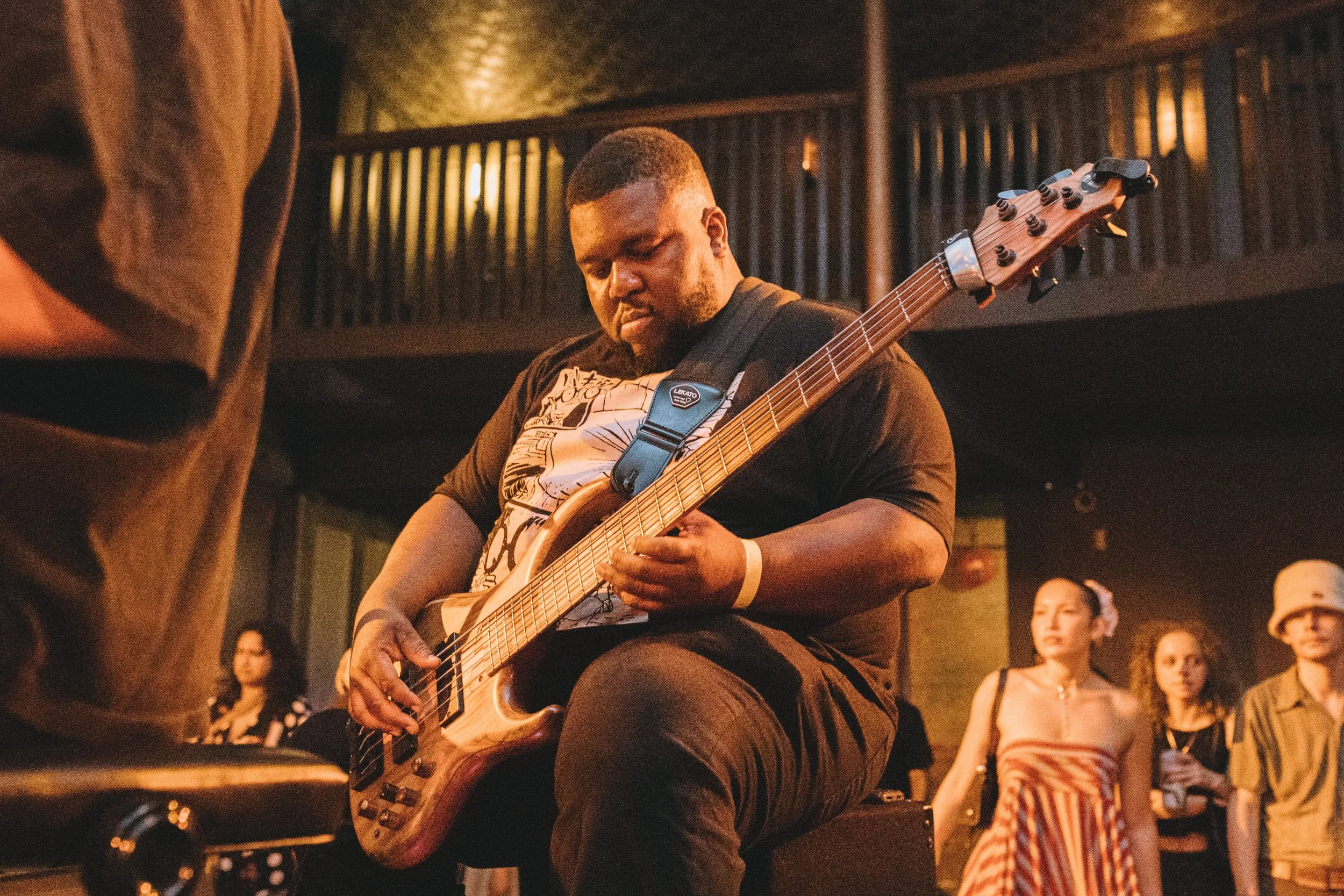
Photograph of Marc Manhertz, Courtesy of The Listening Room
The career he has now, to many (including him) seemed like a dream. “Growing up in the afro-diaspora, there are 4 career pathways: doctor, lawyer, teacher or engineer” he explains. “Luckily, my parents were supportive and more than anything just wanted me to be a self-starter.” That mindset and drive would become an important foundation for navigating the economy of Toronto arts, where gigs can be low-paying and few and far between. “Working in the arts space, you can have a vision for what you want to do but that might not pay the rent or even the phone bill some months” he says.
While continuing to practice his craft and develop his sound, he pursued a business degree - a choice that he continues to reap the benefits of as he expands his career in 2025. But, Manhertz emphasizes that the journey hasn’t been easy. “In the near 20 years that he has been playing bass semi-professionally, Manhertz has always worked odd jobs to supplement his gig money. "I've worked every job you can think of” he says. “From factory jobs to Sam's Club, call centre for a minute while still taking gigs and practicing all the time”. For the last fifteen years, Manhertz (who is also a husband and father) has been working in facilities management with the Toronto District School Board. "I take a lot of pride in my job and when I do it, I apply the same principles as I do in music. If I’m waxing a floor, I want to do it to the best of my ability. I’m not gonna lie and say it hasn’t been challenging, because it is, but I’ve been able to balance it. But I’m lucky enough to have found a job that allows me to pursue my passion”. Looking back at his past today, Manhertz’s tenacity and dedication to his craft has paid off - which is admirable and commendable. At the same time, it’s striking that there are few career pathways that require the kind of juggling act that the economy demands of artists.
Just this past year, sax-player Jelani Watson got an email from the folks at Listening Room asking if he would join the house band for their Cleo Sol night. Like Manhertz, Watson grew up playing music in the church - alternating between keys and sax as needed by the praise team. “Church is a place that makes you check your ego at the door,” Watson explains. “Gospel musicians are some of the best in the world and I’ll stand by that. It comes from having somewhere you play every week that is high intensity. You start playing from young with no sheet music. Most of us are self taught”. When he got the call from the Listening Room, Watson admits that it was a huge confidence boost for him. He’d put aside the ticket money and attended the event a number of times, hopping on stage with the band when they opened up for improv towards the end of the night. Despite an over 10 year age gap, in some ways - Watson’s experience has mirrored Manhertz’s. “As a teenager, when my Jamaican mother was asking me how I was going to get out of her house and pay bills with music - I didn’t have a good answer. So I ended up doing civil engineering at York”. The son of a carpenter with a natural inclination towards planning, structure and physics - the decision wasn’t completely out of the realm of possibility. Still, he couldn’t kick the music bug and continued to take lessons and practice. “After the first two weeks of classes, I knew I still wanted to do music. I stuck it out and I’m happy that I did.” After graduating from York, he continued his education in Humber College’s music business program. It’s a decision that he is grateful for, as the knowledge gained through that education has been important in the economical decisionmaking around pursuing a career in the arts. “The biggest question for me was always, ‘how do I live’ and the program helped with that’, he explains. One of his big wins was scoring a full-time job at Jazz FM through an internship he gained as a result of the program. In that space, Watson is able to keep the bills paid and stay in a working environment where music remains at the forefront.
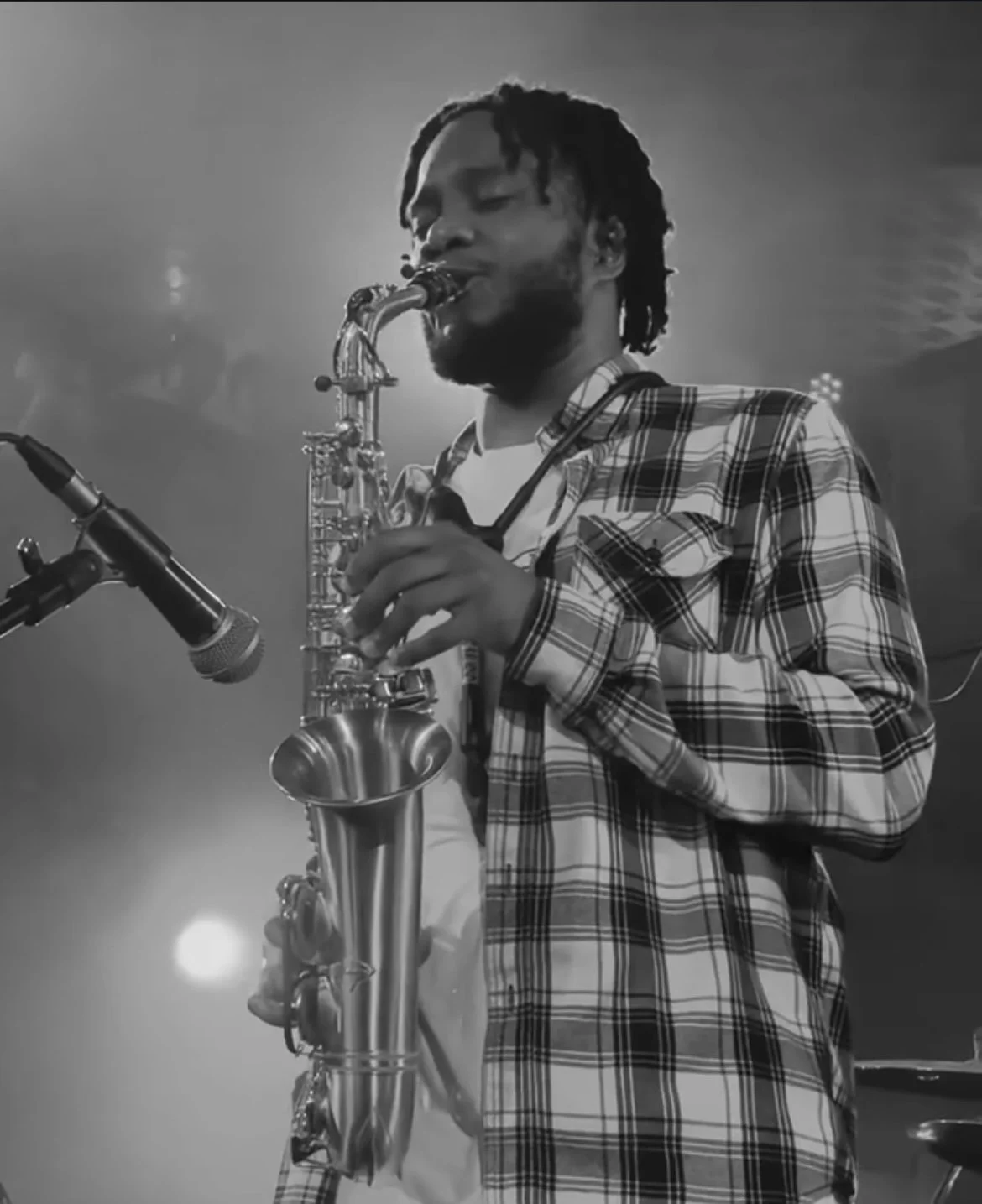
Photograph of Jelani Watson, Courtesy of The Listening Room
For both these artists, there is a constant balancing act of pursuing artistic work and keeping themselves and family afloat financially. In a city where venues are closing, promoters are skimping on artist fees and people in corporate jobs are on the hunt for side hustles - music alone is not the path to financial freedom. On top of his full time job, Watson has maintained a position in Parks and Recreation with the City of Toronto since the 11th grade, doing drop-in work for supplemental income. He continues to gig professionally and teach music to students to pad that as well. There are real costs to this type of lifestyle, both for the artists and for the city. Author Toni Morrison once said “this is precisely the time when artists go to work. There is no time for despair, no place for self-pity, no need for silence, no room for fear… that is how civilizations heal”. In times where folks are apathetic about our political conditions, the cost of living and the spiritual decay of our societies - art is a resource that allows us to transgress reality and imagine more for ourselves.
In spite of the harsh reality, both Watson and Manhertz remain optimistic in the way that only those who create out of love for the craft can. “Everything is possible in this city” Manhertz says, earnestly. “I’m reminded of that every night when I’m on stage with these guys. I won’t lie to you, it is hard, especially after long nights when you gotta think about going to work early in the morning, but I wouldn’t change anything”. Watson agrees, noting that the community of musicians he has found, including Manhertz, have been integral to keeping up his spirits and keeping him devoted to pursuing this path. When we talk about what message they would want to leave for other artists, Manhertz urges that you can’t measure yourself in comparison to anyone else. “Once you determine what success looks like for you, you’ll become comfortable with the path that you’re on… I have friends that are doing this full time, at the highest level - and I have to know that those blessings and success will come back around to me”.
Toronto is a city often accused of not having much of an identity. Where construction in the downtown core seeks to make the city bland and palatable to international consumers and our cultural festivals and artistic productions are fed back to us by Scotiabank and RBC, it is artists who colour the city for us. With the average cost of a one-bedroom apartment sitting at $2600, and prices gouged at major grocery stores: real economic distress is palpable at each corner of the GTA. In the midst of this, it is artists and cultural workers who continue the effort to make meaning of these experiences and reflect ourselves back to us. In a time when more people than ever are asking “what happened to our communities, what happened to our third spaces?”, we forget that artists are an integral part of creating and sustaining those spaces. As we continue to seek a more radical future, we will be forced to consider how we the people can politically and economically support artists who are doing the work that sustains us all.
You can support the work of the artists in this feature by following them on social media @macmanhertz and @jelaniwatson and purchasing their available music.