
Why Alberta separatism and anti-immigration propaganda complement each other
As an organization with a base in Calgary, we have been observing developments in local politics, and we are writing this article to explain to our members why anti-immigration sentiments dovetail with the separatist movement in Alberta. Although headlined by separatism, five of the questions on the October 19th referendum are directly related to immigration. If they pass, the government could start charging non-permanent residents fees for healthcare and education while making them ineligible for all social programs for housing, childcare, and legal aid. This is a threat that warrants an explanation of its origins and a community mobilization to combat it.
A referendum on a referendum and other useless things
There are a total of ten ballots on the referendum. Outside of the ones related to immigration, the provincial government will not be able to take unilateral action on any of them. The separatist ballot, along with the four other referendum ballots about constitutional changes to Canada, will not lead to any legal changes without immense cooperation from the federal government and other provincial governments. Even if somehow the separatist ballot wins a majority, Alberta will not become independent, but instead “begin the process” of negotiating with the federal government for independence, a process that would require another referendum. The ballots on constitutional changes would require a majority agreement from the federal government and other provinces to take effect, something that virtually no one in the country outside of Alberta has any interest in. So, just like the 2021 Alberta referendum against equalization that led to nothing, the issues on these ballots will also go nowhere.
Why is Alberta separatism so prominent?
Alberta (and broader Western Canadian) separatists have been around for decades, and despite how vocal they are, polls consistently show that most Albertans prefer to remain a province of Canada¹. If you find pollsters to be unreliable, then you can instead look at the catalyst for the referendum. The Stay Free Alberta citizen initiative that spurred this referendum received 150,000 fewer signatures than a competing citizen initiative asking for a commitment to remain a province of Canada forever².
However, even if support for Albertan independence really is low, this should not be confused with genuine support for confederation. Many, if not a majority, of the people who would vote against independence still believe that Canada’s federal system needs to be reformed to give Alberta more powers. These people, whom we will refer to as sovereigntists, should be distinguished from more content federalists.
This group is best represented by Alberta’s premier Danielle Smith and her ruling United Conservative Party (UCP) who have popularized the slogan of “a strong and sovereign Alberta within a united Canada” in public comments and the ad campaign for the referendum, one where she encourages Albertans to vote yes (option 2) on all ballots except for separation³. If this comes as a surprise to you, you’re not alone. Her messaging has been purposefully inconsistent, leading many people to believe she supports Alberta separating from Canada⁴. Despite how it looks, Danielle Smith and most of the UCP do not want to found a new nation. All they want are the political and legal changes laid out in the other nine referendum ballots. The UCP sovereigntists are using separatist grassroot organizing support to ensure that they pass, and as potential leverage in negotiations with the federal government. And while most of the separatists have failed to convert the sovereigntists, they have been urging the sovereigntists to vote yes on the separation ballot anyways just to "send a message" to the federal government.
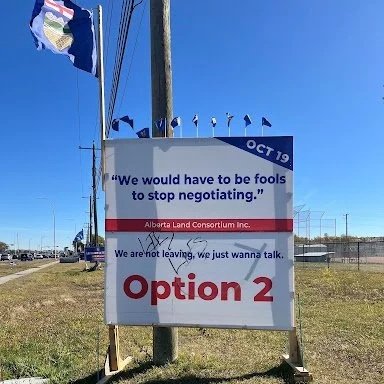
This marriage of convenience works as a pressure campaign against Ottawa but would disintegrate if a real binding separatism referendum were held. For all the aggressive and hostile stances she's taken against the federal government, the premier somehow manages to get teary-eyed at the prospect of Alberta separating from Canada⁵. Even Preston Manning, one of the oldest voices on Western Canadian separatism, who sat beside her as she cried, downplays the separation question in interviews⁶, instead focusing on the four ballots that seek a mandate for Alberta to work on constitutional change to weaken federal powers. Smith and Manning represent the dominant opinion among Alberta’s political elite; separation would be undesirable in practice, but the movement could be a useful threat to extract concessions from the federal government.
What does immigration have to do with Alberta separatism?
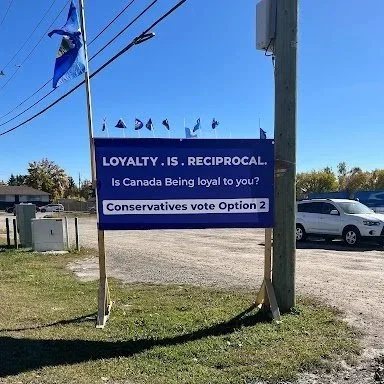
While there is a reasonable debate to be had about the division of powers between provincial and federal governments, the framing of the debate matters. We should ask why a referendum about separation and federalism contains a majority, five out of the ten ballots, for questions related to citizenship and the rights of immigrants in the province? These questions ask if voter ID laws should be introduced, if the provincial government should request final control over immigration, and most concerning, if non-permanent residents should be denied public services or charged a fee for them. What ties separatism, constitutional change, and anti-immigrant policies together is that they can all be used to shift blame for economic conditions away from provincial leadership.
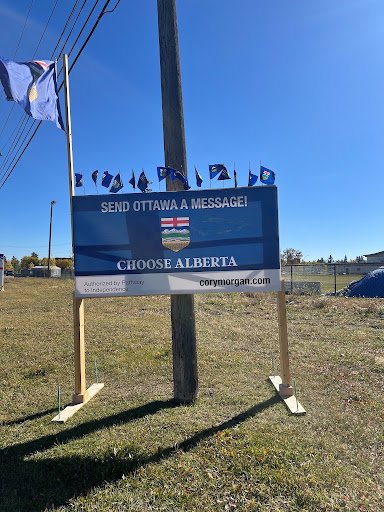
Separatists and sovereigntists alike claim that federal tax schemes, and equalization payments in particular, exploit Alberta’s resources for the benefit of other provinces and that federal (and other provincial) governments have prevented Alberta from building the pipelines needed to export to new markets. And on immigration, they claim that Alberta was forced by the federal government to absorb hundreds of thousands of newcomers that now overwhelm its social services, as well as housing and job markets. You’ll notice that the provincial government is a passive participant in all of this. Apparently, Alberta’s mismanagement of oil revenues (which far exceed equalization payments), under-investment in its public services, and restrictive zoning and public housing policies have played no role in current conditions.
Whether Alberta stays or leaves confederation, it will still have to negotiate with neighbouring states for pipeline approvals, something which will be markedly more difficult post-separation. This weaker position would see the discount on oil sold to America get even worse, more than offsetting what the province would save without federal taxes. Separation also wouldn't change Alberta's need for immigrant workers. Alberta, like other capitalist economies, is reliant on a class of immigrant labour to keep goods and services cheap for its own working class and to keep its owners of capital wealthy. Food systems, caregiving, logistics, and higher education are all reliant on this class of worker, and they are not easily replaced. For a recent example of this, we can look at the United Kingdom post-Brexit. Their separation from the EU increased immigration (especially from non-EU) countries⁷. So, it turns out that national political arrangements cannot eliminate these market dynamics.
To be blunt, Alberta accepts immigrants out of necessity, not charity. This is something that the premier herself knows, and it is why less than two years ago she was dreaming of doubling Alberta's population to 10 million people, and lobbying the federal government to help her do it faster⁸. Whatever criticisms you have about Canada’s immigration policy, her and her party were active participants in forming it. The abrupt u-turn in messaging comes down to convenience rather than a genuine change in perspective. They know that charging new workers fees to access public services will not change the structure of Alberta’s labour market. But, it might help placate those who want to blame anyone but themselves and their local leaders for downward mobility.
Separatists and sovereigntists hope that they can keep distracting Albertans from these realities. It is easier to blame the federal government and immigrants than it is to admit that Alberta’s economic problems are structural and a direct consequence of its own industrial and public policy.
In search of Alberta’s missing national culture
Curiously, debates on the separatist and immigration ballots have paid little attention to the idea of an Albertan national identity and culture. The Cree, Dene, Blackfoot, and Stoney nations living in what is now Alberta can point to national identities, languages, and cultures that long precede today’s settler colonies. In contrast, Alberta was a loose collection of trading posts and farms amalgamated into a single territory to facilitate Canada’s Western expansion. The waves of immigrants from across the globe that have arrived in the years since have not developed a distinct Albertan identity or culture, and neither the provincial government nor the separatists have spent much time trying to create one. In Alberta, grievances over federal-provincial revenue splits and the division of powers are the uniting force between the separatists and sovereigntists in lieu of identity or culture. This hole in Alberta’s case for independence led the leader of the Bloc Quebecois to quip that he isn’t sure that “oil and gas qualify to define a culture.”⁹ On a podcast, Danielle Smith attempted a response, saying that Alberta has a culture of entrepreneurship, multiculturalism, and an “incredible” history and relationship with indigenous “partners”, adding that it is an aspirational place where you can build a business, start a family, and buy a home¹⁰. You would be forgiven for mistaking this for an advertisement by a regional commercial bank instead of the culture of a distinct nation. It's no surprise that this is the best she can come up with though, since the quest for provincial autonomy amounts to little more than the freedom to opt-out of Canadian federalism if it gets in the way of corporations and privatizations. We should remember that referendum's push to charge non-permanent residents for healthcare comes amidst a larger healthcare privatization push by the UCP government, one that would become even easier if the province could opt-out of federal programs it did not like.

Ultimately for Smith and many sovereigntists, the Alberta they dream of is more like a set of corporate values than a homeland for a distinct culture. The separatists meanwhile, as a consequence of their demographics, do share a uniting culture. The strongest base of support for separatists is middle-aged rural white conservatives with an eclectic mix of cowboy cosplayers, pro-Americans¹¹, and Christian fundamentalists. Separatist groups insist that this is irrelevant, and that their new republic will be open and welcoming to every Albertan (except of course for the thousands they plan to deport)¹². However, the frequency with which separatist leaders and members alike have bizarre unprompted racist outbursts¹³ suggests something else. The silver lining is that, to our knowledge, none of Canada's white nationalist organizations or their Alberta chapters have endorsed separatism, meaning that the racism in the movement is most likely just a natural overlap rather than a shared strategic vision.
Stepping in when the state fails
No matter what happens next, Alberta’s separatists are not going anywhere. They have promised to mobilize even if their ballot on separation fails, and if against all odds it were to pass, they would have to pressure the sovereigntists in the UCP government to organize a binding referendum that they do not want. On October 19th, nothing about Canadian federalism will change. But if the immigration ballots pass, and the government takes public services and supports away from immigrants, the people in our community will be worse off. It’s been said that we should “hope for the best and plan for the worst” but instead we ask you to plan for the best and plan for the worst. If you are eligible to vote, then vote no on all ballots. And regardless of the result, we ask you to join us in preparation.
Images
Self captured by members of the 1919 Publication Team.
Bibliography
“Alberta Referendum Polls.” 338Canada, 338canada.com/alberta/polls-indy.htm. Accessed 5 Oct. 2026.
You can compare the number of signatures for ‘A Referendum Relating to Alberta Independence’ petition with the ‘Alberta Forever Canada’ petition on the Elections Alberta’s website for past petitions:
“Past Citizen Initiative Petitions.” Elections Alberta, Elections Alberta, 14 Aug. 2026, www.elections.ab.ca/recall-initiative/initiative/past-citizen-initiative-petitions/.Bellefontaine, Michelle. “Alberta Government Launches Ad Campaign on Referendum Questions | CBC News.” CBC News, CBC/Radio Canada, 12 Sept. 2026, www.cbc.ca/news/canada/edmonton/alberta-advertisement-referendum-9.7341466.
Scace, Matthew. “Danielle Smith Denies Watering down Government Messaging on Independence Question.” The Globe and Mail, The Globe and Mail, 22 Sept. 2026, www.theglobeandmail.com/canada/article-alberta-danielle-smith-denies-watering-down-messaging-independence/.
Graveland, Bill. “‘Why Walk Away?’: Emotional Danielle Smith Speaks against Separation at Online Forum.” Thecanadianpressnews.Ca, The Canadian Press, 20 Sept. 2026, www.thecanadianpressnews.ca/prairies_bc/alberta/why-walk-away-emotional-danielle-smith-speaks-against-separation-at-online-forum/article_4efa0724-b1c0-5114-afe7-d172c08daf65.html.
“Alberta Separatism: Is This the Moment Everything Changes? | Preston Manning.” YouTube, Bridge City News, 8 Sept. 2026, www.youtube.com/watch?v=rWGEdIAE4vs.
See:
Blaakman, Steven. The Brexit Paradox: How Leaving the EU Led to More Migration, European Parliamentary Research Service, June 2025, www.europarl.europa.eu/RegData/etudes/BRIE/2025/772910/EPRS_BRI(2025)772910_EN.pdf.
Sumption, Madeleine, et al. “Net Migration to the UK.” The Migration Observatory, University of Oxford, 27 May 2026, migrationobservatory.ox.ac.uk/resources/briefings/long-term-international-migration-flows-to-and-from-the-uk/.
See
“#575 - Danielle Smith.” Spotify, Shaun Newman Podcast, 29 Jan. 2024, open.spotify.com/episode/3yIyS2AKXtRc7w5KNs4XAa. Accessed 5 Oct. 2026. Timestamp: 27:20 - 29:58.
Smith, Danielle. “Premier Smith Letter to PM Trudeau.” Alberta.Ca, Office of the Premier, www.alberta.ca/system/files/premier-smith-letter-to-pm-trudeau.pdf. Accessed 5 Oct. 2026.
Legree, Davis. “Bloc Leader Says Alberta Must Define Itself as a Nation to Separate from Canada.” iPolitics, 7 May 2025, www.ipolitics.ca/2025/05/07/bloc-leader-says-alberta-must-define-itself-as-a-nation-to-separate-from-canada/.
“EXCLUSIVE: Premier Danielle Smith on AB Separation.” YouTube, Real Talk Ryan Jespersen, 18 May 2025, www.youtube.com/live/Qi30cTE3BfI?t=123s. Timestamp: 10:36 - 11:30.
For an overview of American influence on the Alberta separatists see:
Tait, Carrie, et al. "The Elephant in the Room: Alberta Separatists have Gone to D.C. Offering Fresh Water and Oil in Exchange for American Support – and Republican Operatives have Provided Tactical Assistance Inside the Province." The Globe and Mail (Online)The Globe and Mail, 2026. ProQuest, https://www.proquest.com/blogs-podcasts-websites/elephant-room/docview/3394916976/se-2.
The APP’s draft ‘Immigration and Deportation Plan’ plans to reassess all non-permanent and permanent residents according to a points system and deport those whose points fall under their threshold. They estimate this to be somewhere between 20,000 - 45,000 deportations a year for at least the first three years after implementation.
The Value of Freedom, Alberta Prosperity Project, albertaprosperityproject.com/wp-content/uploads/2025/11/Value_of_Freedom-DraftFiscal-Plan-10July2025.pdf. Accessed 5 Oct. 2026.
There are too many instances to provide an exhaustive list, but here are a few
Sandor, Steven. “Anti-Racism Watchdog Fields Complaint Arising from Immigration Comments Made at Separatist Town Hall.” Edmonton Journal, 16 Jan. 2026, edmontonjournal.com/news/local-news/anti-racism-watchdog-field-complaint-arising-from-immigration-comments-made-at-separatist-town-hall.
Ali, Rukhsar. “ridiculous, Racist” Remark Leads to Member’s Exit from Alberta Prosperity Project Events | CBC News, CBC/Radio Canada, 15 Aug. 2026, www.cbc.ca/news/canada/calgary/alberta-prosperity-project-draft-constitution-9.7308280.
Yourex-West, Heather. “Immigrant Groups Say Racism Rising in Alberta as Referendum Looms.” Global News, Global News, 29 Aug. 2026, globalnews.ca/news/12038193/immigrant-groups-say-racism-rising-alberta-referendum/.